Blog · 8 Oct 2026 · 6 min read
Why Cinema Lighting Makes a Podcast Look More Premium
You can have an expensive camera, a great lens, a £3,000 microphone and a beautifully designed studio, but if the lighting is flat, harsh or inconsistent, the final image can still look surprisingly ordinary.
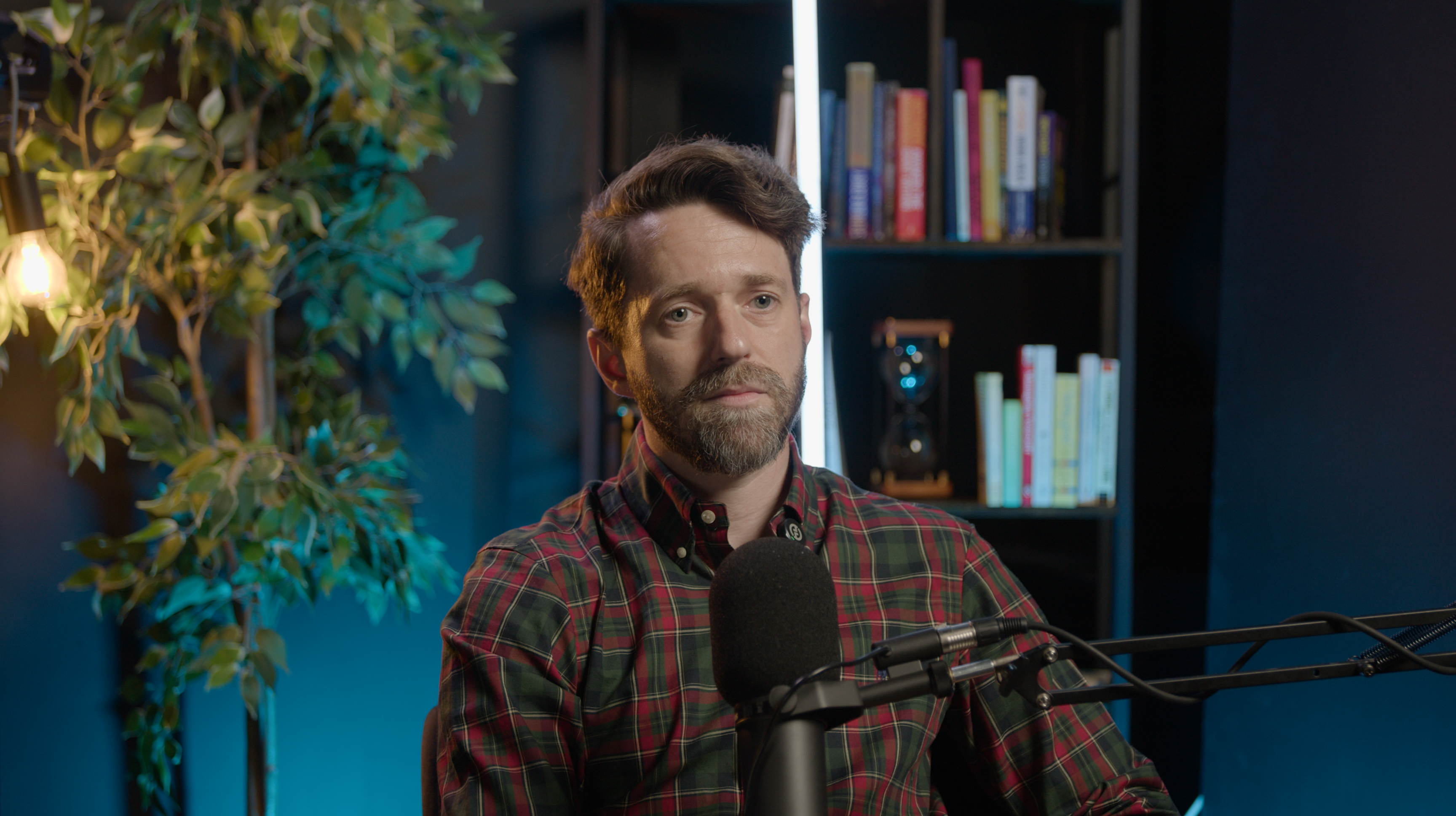
There’s a big difference between a podcast that has been recorded and a podcast that looks like it was produced.
You can have an expensive camera, a great lens, a £3,000 microphone and a beautifully designed studio, but if the lighting is flat, harsh or inconsistent, the final image can still look surprisingly ordinary.
That’s where cinema lighting comes in.
Cinema lighting isn't really about making something brighter. It’s about deciding what the viewer should notice, creating depth in the frame, and making the person on camera look their best without making the lighting itself obvious.
And for podcasts, that matters more than people realise.
Good lighting gives the camera something to work with
Modern cameras are incredibly capable, but they still need good light.
When you light someone properly, you give the camera clean skin tones, better contrast and more detail to capture. You can also keep your ISO lower, which helps reduce noise and gives the image a cleaner, more polished appearance.
But the biggest difference isn't necessarily technical.
It's dimensional.
A basic podcast setup often puts a light directly in front of the host. The face is illuminated, but everything else is left to chance. The result can be very flat: face, chair, wall, background — all sitting on roughly the same visual plane.
Cinema lighting approaches the scene differently.
A soft key light can shape the face. A subtle fill can control the shadows. A backlight or edge light can separate the subject from the background. Then you can light elements of the set independently to create depth.
Suddenly, the person doesn't look like they've been placed in front of a backdrop.
They look like they're in a scene.
That's a subtle distinction, but it's one of the things that makes professional film and television look professional.
The goal isn't to make everything bright
One of the biggest mistakes in podcast lighting is trying to eliminate every shadow.
Shadows aren't the enemy.
In fact, they're one of the things that make an image interesting.
Cinema lighting uses contrast deliberately. You might have a beautifully exposed face while allowing parts of the room to fall away into darker tones. You might put a warmer practical light in the background while keeping the subject slightly cooler. You might use a pool of light to draw attention to a particular part of the set.
The result is an image with somewhere for the eye to go.
And that's important in a format where someone might be watching two people talk for an hour.
You don't want the visual experience to feel like a webcam call.
You want it to feel like a programme.
Why premium-looking content matters
There is also a psychological element to this.
Viewers make judgements about production quality very quickly. Research into production value has found that viewers can recognise differences in production quality and tend to judge higher-production-value video as more credible, even when the underlying content is otherwise the same.
More recent research has also found that people prefer higher-quality video and that poorer video quality can reduce enjoyment and people's intention to keep watching.
That doesn't mean beautiful lighting magically makes boring content interesting.
It doesn't.
The conversation still has to be good.
But presentation changes the first impression, and the first impression determines whether somebody gives the conversation enough time to become interesting.
Think about it in the real world.
If someone walks into a meeting looking sharp, speaking confidently and clearly, you probably form an opinion of them before they've finished their first sentence.
The same thing happens on screen.
Someone who looks polished, sounds polished and is surrounded by a polished environment immediately feels more intentional.
The viewer doesn't necessarily sit there thinking, "That's a fantastic key-to-fill ratio."
They just think:
This looks good.
And that's exactly the point.
Lighting can make a podcast feel expensive without looking over-produced
The best podcast lighting usually isn't the lighting you notice.
It's the lighting that makes everything else look better.
Skin looks natural. Eyes have a little sparkle. The background has depth. There's separation between the presenter and the set. Colours feel intentional. Nothing is blowing out, and nothing important is disappearing into darkness.
It feels effortless.
That's actually quite difficult to achieve.
A cinematic setup might involve a large, soft source positioned slightly off-axis rather than a small light pointed directly at someone's face. The background can then be treated separately, using practicals, accent lights or controlled pools of light.
You can also introduce colour very carefully.
A warm lamp behind the subject. A cooler edge light. A little separation from a darker background.
None of these things have to scream "cinematic."
They simply give the image more information.
The camera isn't always the most important upgrade
This is something podcast studios and creators sometimes get backwards.
People will spend thousands upgrading a camera and then put a £50 LED panel directly in front of the presenter.
The camera is only one part of the image.
Lighting determines what that camera actually sees.
A relatively modest camera with excellent lighting can look far more impressive than an expensive camera in a badly lit room.
That's because viewers don't experience your production as a list of specifications. They experience the finished image.
They don't care whether you're shooting on a cinema camera or a mirrorless body if the image looks flat.
And they don't necessarily care if you've spent a fortune on the camera if the person on screen looks badly lit.
The premium look is really about consistency
There's another advantage to cinema lighting that becomes particularly important for podcasts: consistency.
A podcast might produce dozens or even hundreds of episodes.
If you're relying on whatever daylight happens to come through a window, your image can change dramatically from one recording to another.
Cloud moves across the sky.
The sun moves.
The colour of the room changes.
Suddenly episode 42 looks completely different from episode 41.
Controlled lighting removes a lot of that uncertainty.
You can build a look and repeat it.
That consistency becomes part of the show's identity.
Over time, viewers begin to recognise the visual language of the podcast before they've even read the title.
So, what makes cinema lighting better?
Ultimately, it's not about owning the most lights.
It's about controlling the image.
Cinema lighting gives you control over:
Depth — separating the presenter from the background.
Shape — using light and shadow to give the face dimension.
Mood — making the environment feel warm, serious, energetic or intimate.
Focus — directing the viewer's eyes towards what matters.
Consistency — creating the same visual identity episode after episode.
Quality — giving the camera clean, controlled light to capture.
And perhaps most importantly, it gives the audience a reason to stay in the visual world you've created.
Because podcasting isn't just an audio medium anymore.
People are watching.
They're seeing the host's expressions, the studio, the set, the guest and the quality of the production. YouTube's own research into video quality found that audiences increasingly expect content to work on both a technical and emotional level — good visuals alone aren't enough, but poor visuals can undermine the experience.
That's the real argument for cinema lighting.
It isn't about making a podcast look flashy.
It's about removing the visual distractions, creating a stronger first impression and making the conversation feel worth spending time with.
When the lighting is right, the viewer doesn't think about the lighting.
They think the podcast looks premium.
And in a world where there are thousands of other videos competing for their attention, that's a pretty valuable first impression.
Fancy making one of your own?